
Known for its elegance and grace, the demoiselle crane (Anthropoides virgo) is the smallest crane species, often admired for its delicate appearance.
Its scientific name combines the Greek “anthropoides,” meaning “human-like,” with the Latin “virgo,” meaning “young lady,” symbolizing its refined movements.
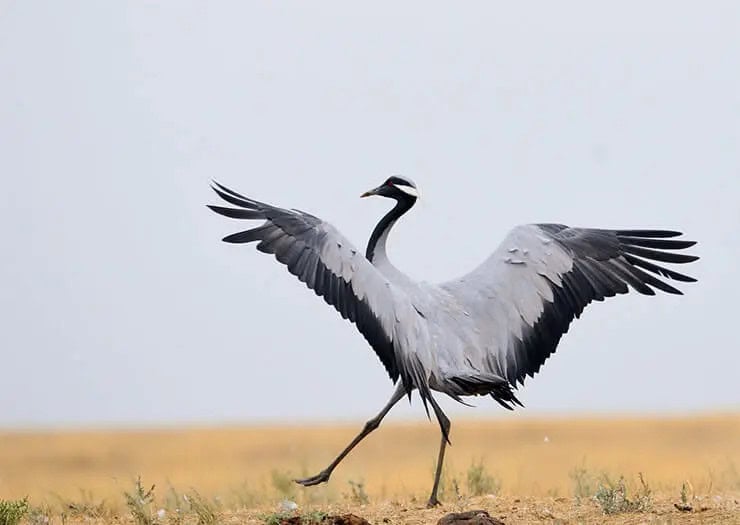
This name is thought to have been inspired by Marie Antoinette, who, upon seeing a crane’s elegant display, referred to it as “Demoiselle,” meaning young lady.
Habitat and Migration
The demoiselle crane inhabits southern Europe, central Asia, and northern Africa, favoring open, dry landscapes like savannahs, grasslands, and steppes. During winter, it migrates to regions in Africa and India, finding sanctuary in savannahs, grasslands, and areas near water.
These birds prefer nesting sites close to water sources, even in desert areas. Despite its size, spotting one can be challenging, as it migrates at high altitudes over long distances and nests in remote regions.
Physical Characteristics
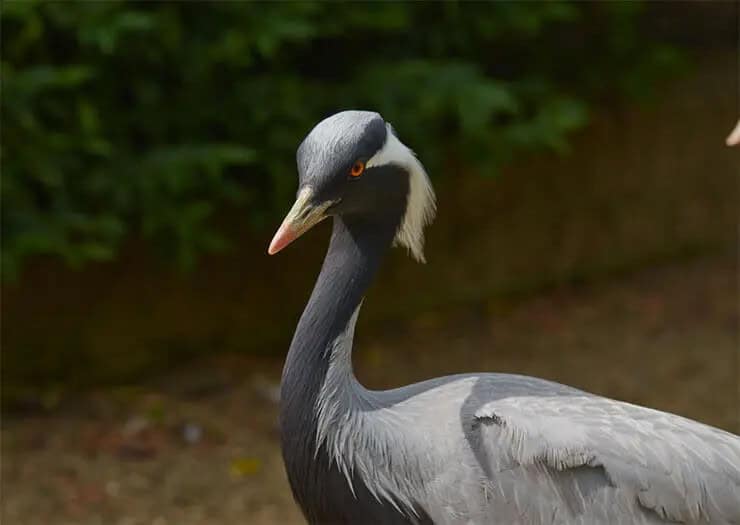
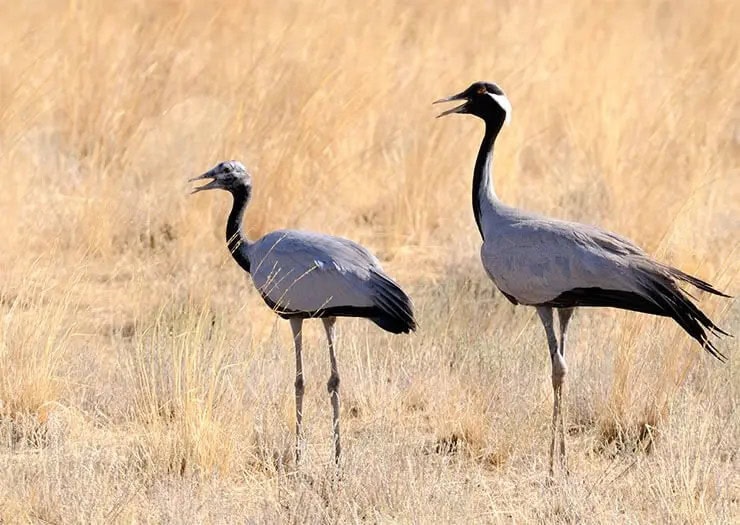
With a length of 85-95 cm and a wingspan of 155-180 cm, the demoiselle crane weighs between 2-2.7 kg. Its plumage is primarily grayish-blue, with a striking black chest and neck. Distinct white feathers extend from behind each eye, creating a crest that adds to its refined look.
The demoiselle crane’s beak is short and red-tipped, as is the area around its eyes. Unlike adults, young cranes have brown-gray feathers and lack the distinctive white crest.
Diet and Feeding Habits
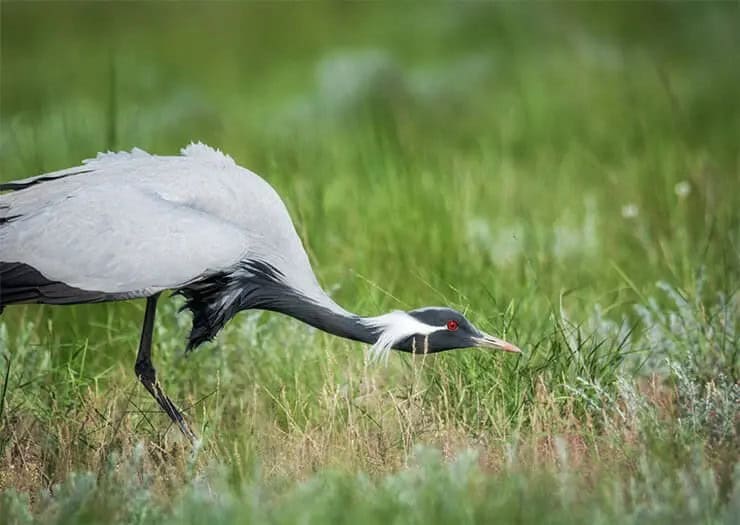
Demoiselle cranes are omnivorous, feeding on seeds, leaves, fruits, insects, reptiles, and small mammals. Their diet varies seasonally; in autumn and winter, they feed on grains found in fields, while in spring they graze on fresh crop shoots.
Social Behavior and Breeding
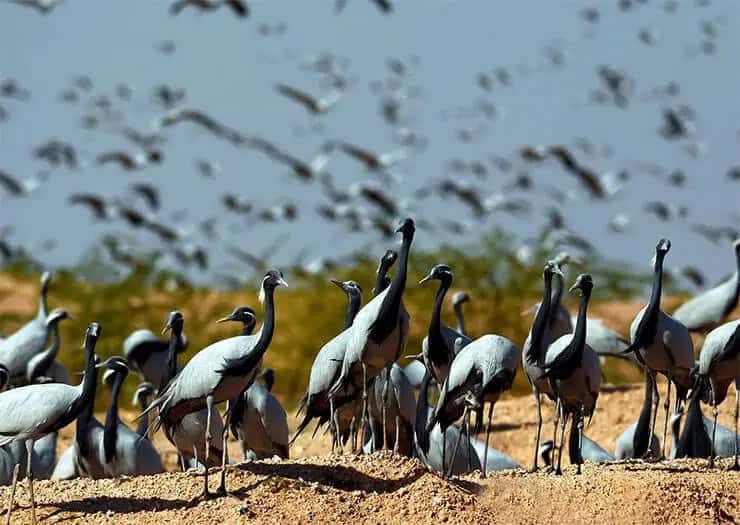
Social by nature, demoiselle cranes often form large groups, sometimes joining other crane species. They perform intricate dances throughout the year, thought to strengthen pair bonds, especially during the breeding season. These performances become even more expressive, with spins, jumps, and elaborate stretches.
From April to June, the female lays eggs in simple nests made of shallow soil depressions near water. After an incubation period of about four weeks, the chicks emerge and can fly within a few months.
Conservation Status
According to the International Union for Conservation of Nature (IUCN), the demoiselle crane is classified as “Least Concern,” with an estimated population of 200,000-240,000.
However, habitat loss and degradation pose a significant threat, as do hunting practices in parts of India and East Africa. Additionally, feral dogs often prey on these cranes, further endangering their numbers.
With their exquisite appearance and graceful displays, demoiselle cranes continue to capture the admiration of bird enthusiasts, although conservation efforts are necessary to protect their habitats and populations for future generations.
Read More Birds